Fund Domiciles / Luxembourg / Fund Vehicles
RAIF, SIF, SICAR, and Limited Partnerships — how each is legally constituted, who can invest, what oversight applies, and how they're commonly combined with SOPARFI holding structures. This is the detail behind the comparison on the main Luxembourg page.
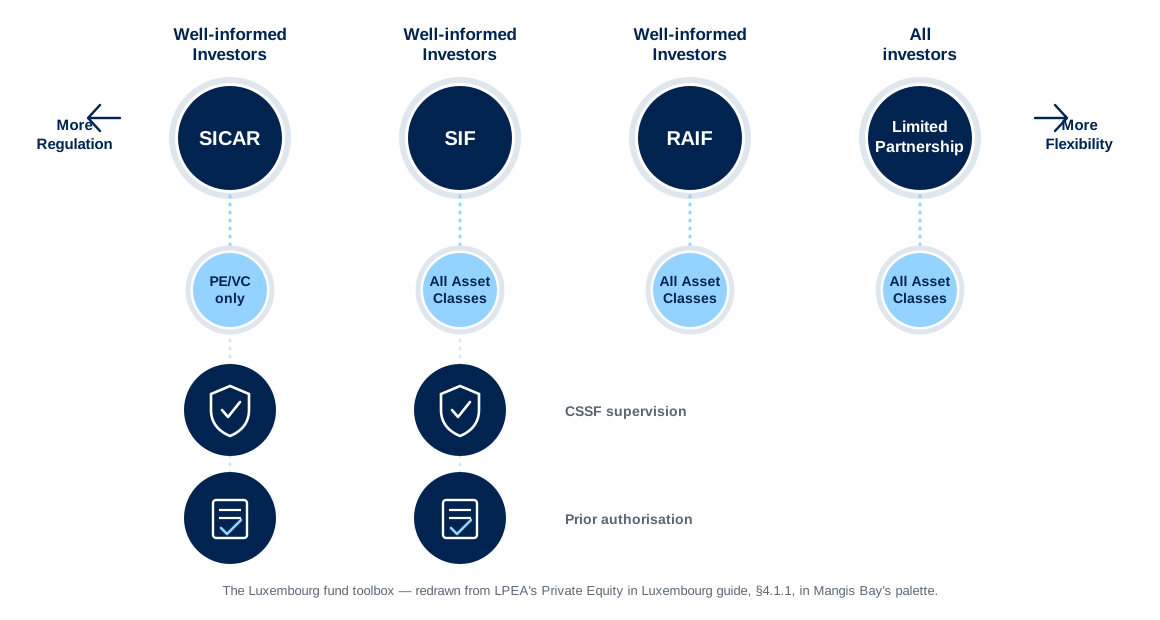
The full version of the comparison table used across this site — for the four principal Luxembourg private markets vehicles.
Redrawn from LPEA Private Equity in Luxembourg guide, §4.1.1, in Mangis Bay's palette.
| Feature | SIF | SICAR | RAIF | Limited Partnership |
|---|---|---|---|---|
| Eligible assets | Unrestricted | PE/VC (risk capital) only | Unrestricted (unless SICAR opt-in) | Unrestricted |
| Eligible investors | Well-informed | Well-informed | Well-informed | Unrestricted |
| Legal regime | Law of 13 Feb 2007 | Law of 15 June 2004 | Law of 23 July 2016 | Limited partnership agreement |
| Required providers | AIFM, depositary, auditor | AIFM, depositary, auditor | AIFM, depositary, auditor | Authorised AIFM if AIF |
| Risk spreading? | Yes (max 30%/issuer) | No | Yes, unless SICAR opt-in | No |
| CSSF supervision? | Yes — direct | Yes — direct | No — indirect via AIFM | No |
| Legal forms | FCP or SICAV/SICAF | Corporate only | FCP or SICAV/SICAF | SCS or SCSp |
| Minimum capital | €1,250,000 | €1,000,000 | €1,250,000 | None (LPA-driven) |
| AIFMD / ELTIF compatible | Yes / Yes | Yes / Yes | Yes / Yes | Yes / Yes |
Sources: LPEA Private Equity in Luxembourg guide (May 2026), Annex 1; Bonn Steichen & Partners, Investment Management in Luxembourg. Note: sources differ on the exact window for reaching minimum capital (LPEA states 12 months from formation/authorisation; other Luxembourg counsel cite up to 24 months) — confirm the applicable timeline with legal counsel for your specific structure.
The SIF is Luxembourg's tried-and-tested, directly CSSF-supervised vehicle. It can pursue almost any investment strategy — private equity, real estate, hedge, infrastructure, or a UCITS-style multi-strategy platform via sub-funds — while remaining lightly regulated compared to a retail fund.
Restricted to "well-informed investors": (i) institutional investors, (ii) professional investors, or (iii) any other investor who confirms in writing that they adhere to well-informed status and either invests a minimum of €100,000, or has their expertise certified by a credit institution, investment firm or management company. Directors and persons involved in managing the SIF are exempt from these conditions.
A SIF must follow the principle of risk-spreading: in practice, no more than 30% of assets or commitments may be exposed to a single "risk" (issuer), though a grace period applies while the portfolio is being built, and derogations are sometimes available.
Before launch, the CSSF must approve the prospectus and constitutive documents, the choice of directors/managers, the management company, the central administration, the depositary and the auditor. Any substantial change thereafter — to the prospectus, constitutive documents, directors, or key service providers — again requires prior CSSF approval.
Weighing a SIF against a RAIF for your strategy? We help you make the call — and coordinate the CSSF approval process end to end.
Talk to Mangis Bay →The SICAR is purpose-built for private equity and venture capital investing in risk capital — defined by CSSF Circular 06/241 as the combination of high risk and an intention to develop the target entities. Unlike the SIF, it carries no risk-diversification requirement, making it suited to concentrated, high-conviction strategies.
Same well-informed investor test as the SIF. Eligible assets are restricted to risk capital only — direct or indirect contributions to entities in view of their launch, development, or listing.
A SICAR can only be set up as an investment company — never as an FCP. Available forms: SA, SCA, Sàrl, cooperative company in the form of an SA (SCoSA), SCS or SCSp.
SICARs in partnership form (SCS/SCSp) are generally tax transparent. SICARs in corporate form are fully taxable companies, but income from transferable securities qualifying as risk-capital investments — and income from funds held for up to 12 months pending investment — is tax exempt. No net wealth tax beyond the minimum, and no withholding tax on distributions.
Running a concentrated PE/VC strategy? We help structure the SICAR and select an auditor with genuine risk-capital experience.
Talk to Mangis Bay →The RAIF adopts most of the features of the SIF or SICAR, but is not itself authorised or supervised by the CSSF — supervision instead happens indirectly, through the mandatory appointment of a fully authorised external AIFM. This makes the RAIF the fastest regulated-equivalent route to market, and today's most popular Luxembourg private equity vehicle alongside the SCSp.
A RAIF defaults to a "SIF-like" regime (unrestricted assets, 30% risk-spreading requirement, no CIT/NWT, 0.01–0.05% subscription tax). It can instead opt into a "SICAR-like" regime if it restricts itself to risk capital investments — trading the SIF-like tax exemption for SICAR-style taxation (fully taxable with risk-capital income exempt, minimum NWT only, no subscription tax). This choice should be made deliberately, with tax advice.
The RAIF is not subject to CSSF approval or ongoing supervision as a product, but must submit certain AML-related reports to the AED. It must appoint a Luxembourg depositary and auditor, and — unlike the SIF/SICAR — is required (not merely permitted) to appoint an authorised AIFM, based in Luxembourg or another EU/EEA member state.
Choosing between the RAIF-SIF and RAIF-SICAR tax regimes is a real decision, not a formality. We help you and your tax advisor get it right from day one.
Talk to Mangis Bay →Luxembourg's most popular private equity vehicle today: 61% of surveyed managers use an unregulated SCSp. Both the SCS (common limited partnership) and SCSp (special limited partnership) have at least one general partner with unlimited liability and one or more limited partners whose liability is capped at their commitment. The SCSp is purely contractual and carries no legal personality — offering the greatest structuring flexibility of any Luxembourg vehicle.
Neither the SCS nor SCSp is subject to a specific product law, CSSF approval, or ongoing supervision. If the partnership qualifies as an AIF and its manager's assets under management exceed the AIFMD de minimis thresholds (€100m leveraged / €500m unleveraged) — or it simply wants the AIFMD marketing passport — it must appoint an authorised AIFM, which then unlocks EU-wide marketing.
An unregulated SCS or SCSp can convert into a regulated SIF or SICAR at any time — a common way to launch quickly and add regulatory status later if investor demand requires it. Limited Partnerships can also be used directly as the legal form underlying a SIF, SICAR or RAIF.
Fastest route to launch — but the LPA does the heavy lifting. We help coordinate legal counsel and get your SCSp market-ready in 1–3 months.
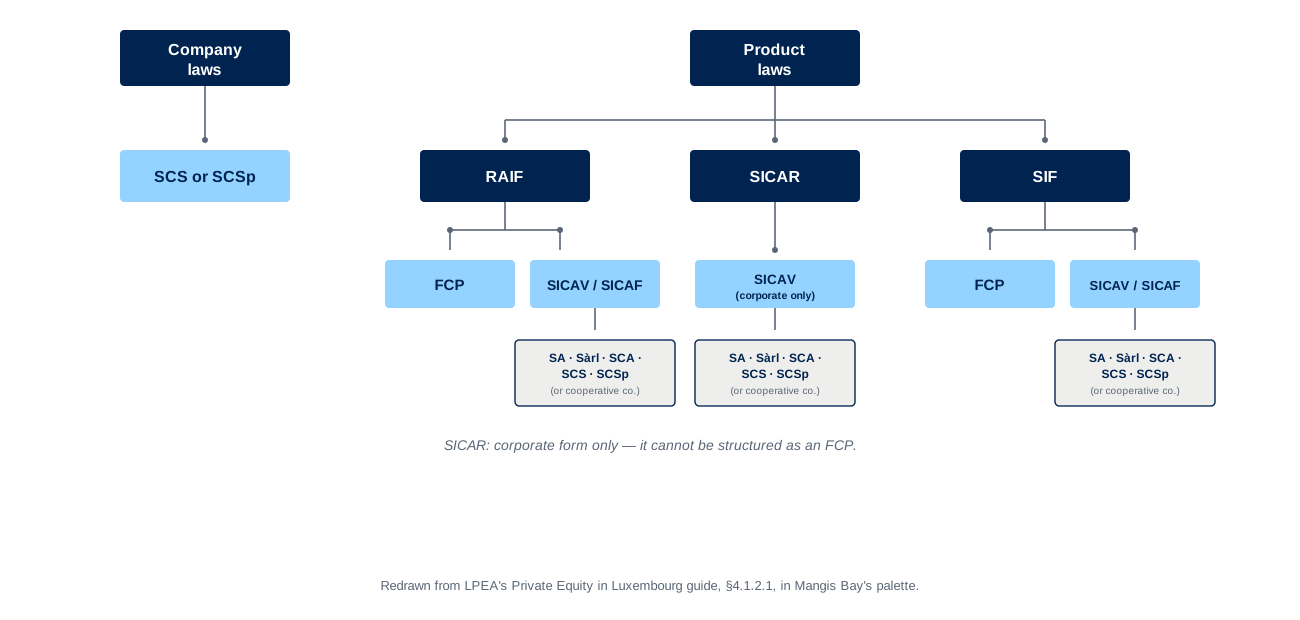
Talk to Mangis Bay →Choosing SIF, SICAR or RAIF (the "product law") is one decision. Choosing the legal form the vehicle takes — contractual (FCP) or corporate (SICAV/SICAF/partnership) — is a separate one, driven mostly by investor tax position and how much control the sponsor wants to retain.
Redrawn from LPEA Private Equity in Luxembourg guide, §4.1.2.1, in Mangis Bay's palette.
Beyond picking a vehicle, most Luxembourg structures layer in one or more of the following — often several at once.
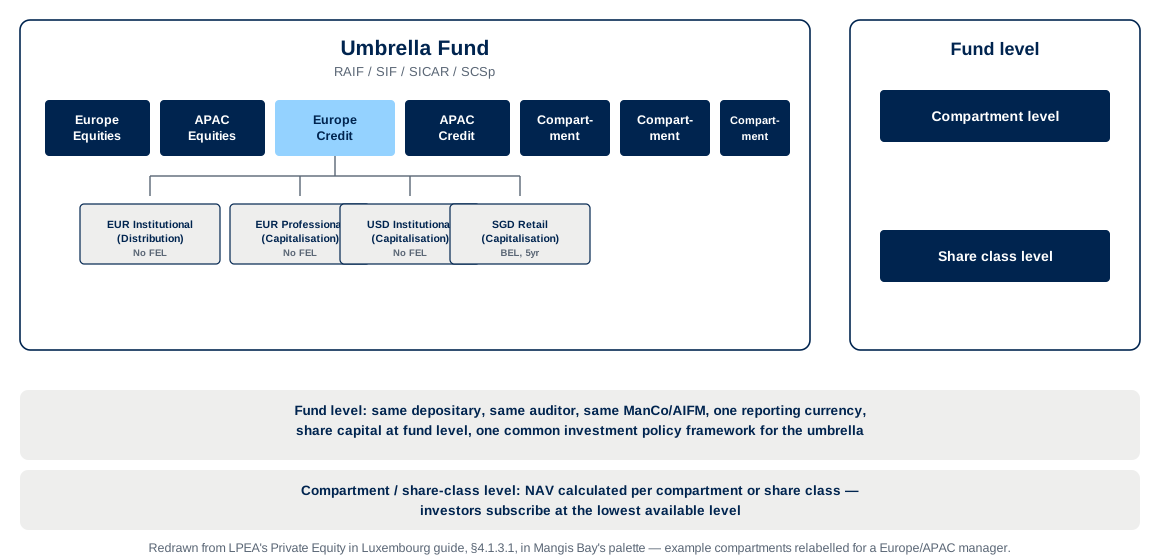
The RAIF, SIF and SICAR laws each allow an "umbrella fund" — segregated compartments within one legal entity, each with its own investment policy, asset pool and investor base. A compartment's assets are ring-fenced: only investors and creditors of that compartment can claim against it. All compartments share a single depositary, auditor, and AIFM/ManCo. Stand-alone SCS/SCSp/SCA vehicles don't offer this — a new entity is needed per strategy.
Redrawn from LPEA Private Equity in Luxembourg guide, §4.1.3.1, in Mangis Bay's palette — example compartments relabelled for a Europe/APAC manager.
A feeder fund invests at least 85% of its assets into a single master fund (or several masters with identical strategies). Master and feeder can combine a Luxembourg vehicle with a foreign one in either direction — but an authorised AIFM can only market a feeder AIF under the AIFMD passport if the master AIF is itself managed by an authorised EEA AIFM.
A structure investing in several target funds rather than directly in portfolio companies — offering diversification and access for investors who couldn't invest in the underlying funds directly. Common as an entry point for investors new to a strategy or region.
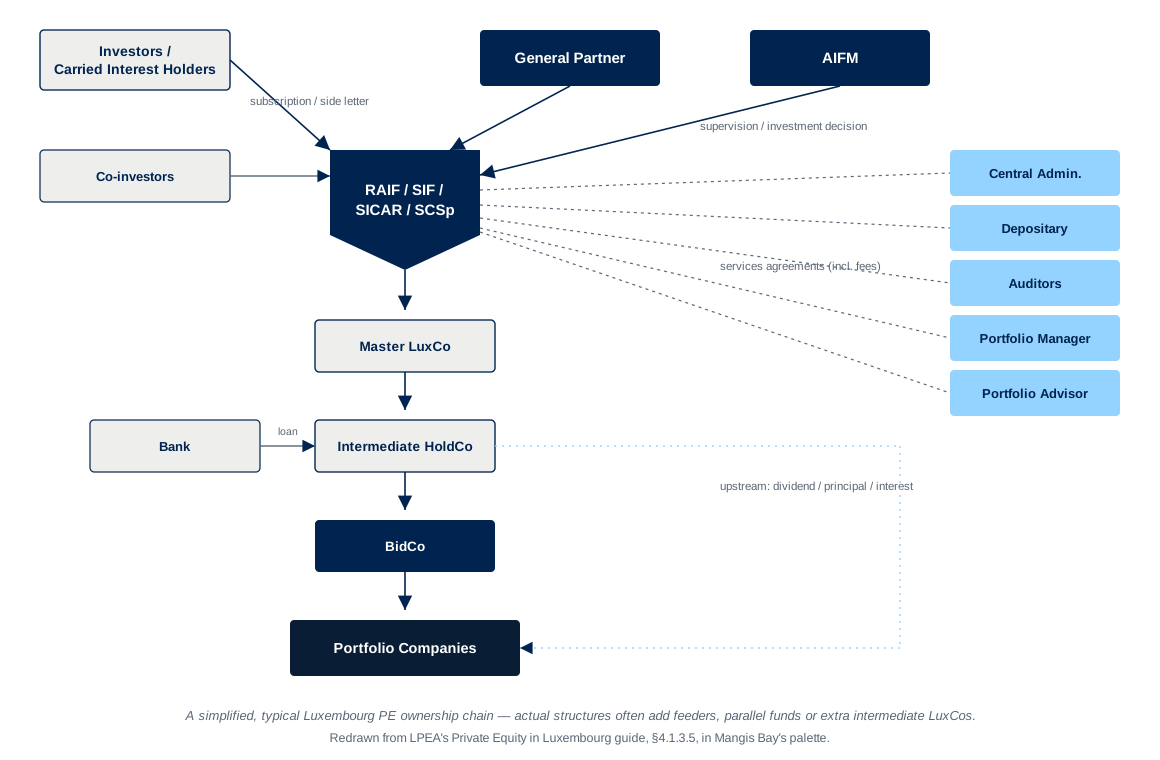
The SOPARFI (Société de Participations Financières) is Luxembourg's standard unregulated holding company — typically an S.à r.l. — used to hold and manage the fund's underlying investments. It benefits from the EU Parent-Subsidiary Directive (full exemption on qualifying dividends and capital gains) and Luxembourg's treaty network — benefits an FCP or tax-transparent SCS/SCSp cannot access directly. Most Luxembourg PE structures combine a RAIF, SICAR, SIF or SCSp at the top with one or more SOPARFIs holding the underlying assets, directly or via a local intermediate entity.
A simplified, typical Luxembourg PE ownership chain — actual structures often add feeders, parallel funds or extra intermediate LuxCos. Redrawn from LPEA Private Equity in Luxembourg guide, §4.1.3.5, in Mangis Bay's palette.
Substance, legal form, AIFM appointment and document drafting — the full step-by-step, with org-chart diagrams.
Read the set-up guide →What central administration, depositaries, TAs, auditors and banks each actually do — and how to select them.
Explore providers →CIT, subscription tax, net wealth tax, withholding tax, carried interest, and the double tax treaty network in detail.
Read the tax guide →