Who we are What we do Who we serve Fund Domiciles Sales-as-a-Service Insights Contact Client Login
Fund Domiciles / Cayman Islands

The default global domicile, tax-neutral by design.

Around 31,000 funds and roughly US$16 trillion in AUM are registered with CIMA — Cayman remains the world's dominant offshore domicile for closed-end private equity and venture capital, built around the Exempted Limited Partnership and a genuinely tax-neutral regime. This page breaks down how it actually works, and how Mangis Bay acts as your gateway into the market.

~31,000

total CIMA-registered funds (private + mutual) as of mid-2026

~$16tn

total AUM across CIMA-registered funds

0%

corporate income tax, capital gains tax, withholding tax or estate duty

4–8 wks

realistic time from decision to first close for a standalone PE/VC fund

$4,125

annual CIMA fee for a registered private fund, effective 1 January 2026

Up to 50 yrs

tax exemption undertaking available for ELPs, LLCs and trusts

Source: Cayman Islands Monetary Authority (CIMA); Cayman Finance industry statistics, mid-2026 release.

Why managers structure here

"Cayman isn't chosen because managers don't know better — it's chosen because the Exempted Limited Partnership, a genuinely tax-neutral regime, and decades of institutional-LP familiarity add up to the lowest-friction path to a global fund launch."

Cayman's appeal for private markets managers is structural, not incidental: the Exempted Limited Partnership Act closely tracks the Delaware Revised Uniform LP Act, giving US institutional LPs and counsel a framework they already know; there is no corporate income tax, capital gains tax, withholding tax or estate duty at any level; and the realistic time from decision to first close is measured in weeks, not months. Add the Private Funds Act's now-established audit, valuation, safekeeping and cash-monitoring regime — which gives institutional investors real comfort without importing onshore complexity — and it's easy to see why roughly 31,000 funds remain domiciled here.

What's less visible from outside Cayman is that the fund vehicle itself is rarely the constraint — legal drafting of the LPA and PPM, and coordinating a registered office, administrator and CIMA-approved auditor, is where real time gets spent. Mangis Bay acts as your gateway to Cayman, helping you appoint the right service providers and sequence the CIMA registration correctly.

Compare Structures

Which vehicle fits your fund?

Cayman offers four principal vehicles for a private markets fund: the Exempted Limited Partnership (dominant for closed-end PE/VC), the Segregated Portfolio Company (for multi-strategy/open-ended platforms), the standard Exempted Company, and the more recent Cayman LLC.

SPC Segregated Portfolio Company
  • Legal personalityYes — one entity, ring-fenced portfolios
  • Umbrella / sub-fundsStatutory ring-fencing per portfolio
  • Eligible investorsDepends on Mutual Funds Act category
  • Typical useMulti-strategy hedge platforms, funds-of-funds
Tax: Same tax-neutral regime as other Cayman vehicles.

Individual segregated portfolios are not separate legal entities and cannot contract with each other — but assets and liabilities are statutorily ring-fenced, upheld by the Grand Court.

Exempted Company Standard corporate vehicle
  • Legal personalityYes — full separate entity
  • SegregationNone without an SPC election
  • Tax undertakingUp to 20 years typical (30-year statutory max)
  • Typical useGP entity, holding vehicle, or open-ended fund
Tax: Fully tax-neutral, same regime as ELP/SPC/LLC.

Typically used as the GP or manager entity sitting above an ELP, or as the fund vehicle itself for open-ended structures where redemption mechanics fit better than partnership capital accounts.

Cayman LLC Limited Liability Company (2016)
  • Legal personalityYes — unlike the ELP
  • GovernanceLLC agreement, not share capital
  • Tax undertakingUp to 50 years available
  • Typical useDelaware-LLC-style alternative to the ELP
Tax: Fully tax-neutral.

For sponsors wanting Delaware-LLC-style familiarity and separate legal personality, without the rigidity of a share-capital company.
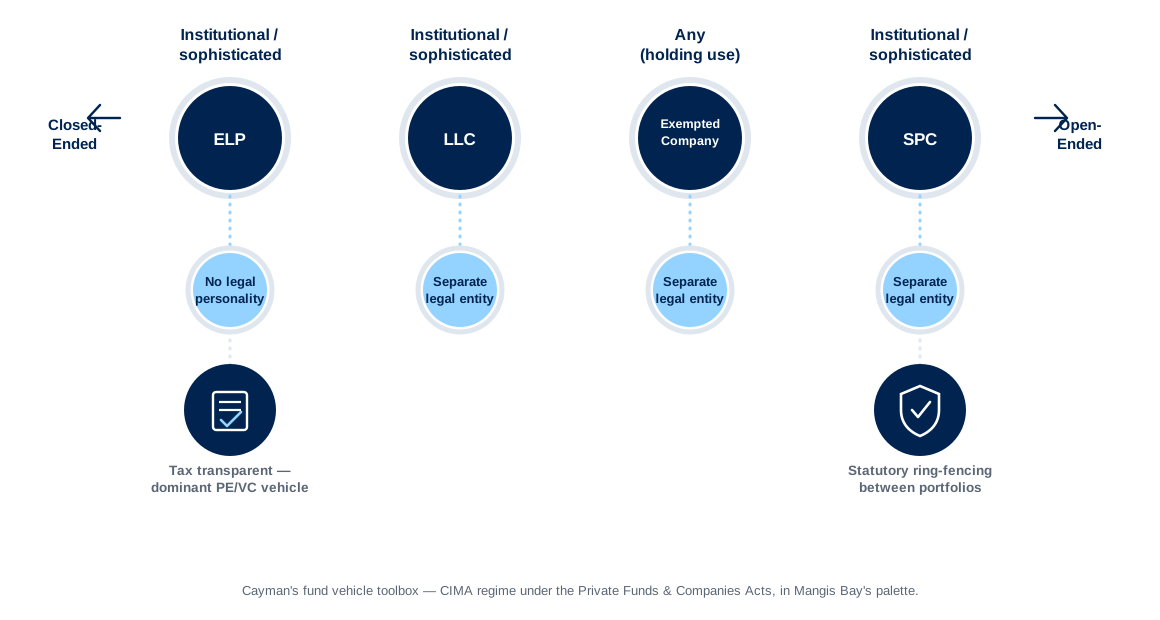
Cayman fund vehicle toolbox — ELP, LLC, Exempted Company and SPC compared by legal personality and structural features

Cayman's fund vehicle toolbox, in Mangis Bay's palette. Source: CIMA; Cayman Islands Companies Act & Exempted Limited Partnership Act.

The Set-up Journey

Four steps from decision to launch.

The vehicle itself is the fast part in Cayman — legal drafting of the LPA and PPM is usually the longest pole. Click each step to see what's involved, and where Mangis Bay typically takes the load off your team.

1

Incorporate the GP & register the ELP

24–48 hours to file, 7–10 days for certificates

Incorporating the GP as an exempted company and registering the ELP with the Registrar can be done within 24–48 hours of submission, though physical certificates take 7–10 working days unless expedited. A registered office provider must be engaged from the outset.

How Mangis Bay helps

We help you choose the right vehicle for your strategy and coordinate the GP/ELP registration alongside Cayman legal counsel.

Talk through your structure →
2

Draft the LPA & PPM

Typically the longest pole — 4–6 weeks

Legal drafting of the limited partnership agreement, private placement memorandum and subscription agreement is typically the longest pole in a Cayman launch, at 4–6 weeks with review cycles — longer than the registration steps either side of it.

How Mangis Bay helps

We help coordinate legal counsel and keep drafting on schedule alongside the parallel CIMA registration and service-provider appointment tracks.

Get drafting support →
3

Register with CIMA under the Private Funds Act

Within 21 days of accepting commitments

Closed-ended private funds must register with CIMA within 21 days of accepting capital commitments (not contributions) — subscription agreements can be signed before registration, but drawdowns cannot happen until registration is complete. Practitioner estimates put actual CIMA processing at roughly 2–4 weeks from a complete submission.

How Mangis Bay helps

We help make sure the audit, valuation, safekeeping and cash-monitoring policies required by the Private Funds Act are properly documented before you file.

See the Private Funds Act requirements ↓
4

Appoint service providers & launch

Administrator, auditor, AML officers

A CIMA-approved local auditor is mandatory, and while a third-party administrator isn't a bright-line legal requirement, institutional LPs expect one as the path of least resistance. Named AML officers (AMLCO, MLRO, DMLRO) must also be appointed before launch.

How Mangis Bay helps

This is where we add the most value: running a structured selection process across administration, audit and AML compliance appointments — see the full breakdown below.

See service providers ↓
Your Cayman Ecosystem

Five providers. One decision at a time.

Choosing the right partners is as important as choosing the right fund vehicle. Click each category to see what it covers and how Mangis Bay helps you select, appoint and manage it.

Registered Office

Mandatory for every exempted company, SPC, ELP and LLC — provided by a CIMA-licensed local provider, maintaining statutory registers and acting as the point of contact for government correspondence.

Mangis Bay's role: we help select a registered office provider suited to your structure's complexity and ongoing compliance needs.

Fund Administration

Not legally mandatory as a third-party appointment — CIMA requires the NAV/valuation function to be functionally independent of portfolio management, however achieved. In practice, institutional LPs expect a licensed third-party administrator.

Mangis Bay's role: we benchmark administrators for sector fit and pricing, and manage the onboarding process.

CIMA-Approved Auditor

Mandatory for both mutual and private funds — audited financial statements and the Fund Annual Return are due within 6 months of year-end (extendable up to 3 months per extension, at a fee).

Mangis Bay's role: we shortlist auditors with genuine private equity experience and manage the appointment and annual filing process.

Independent Directors & AML Officers

Not a bright-line statutory mandate, but near-universal market practice for institutional-grade funds. Named AMLCO, MLRO and DMLRO appointments are mandatory under Cayman's AML regulations — the MLRO cannot be a director or equity holder of the fund.

Mangis Bay's role: we appoint experienced independent directors and help structure compliant AML officer arrangements from day one.

Fund Lifecycle

From preparation to first close.

A realistic total time-to-launch for a standalone Cayman PE/VC fund is roughly 4–8 weeks — a platform/umbrella launch joining an existing structure can be under 4 weeks.

Preparation

  • Incorporate GP & register ELP
  • Draft LPA, PPM & subscription agreement
  • Appoint registered office & administrator

Pre-marketing & marketing

  • Appoint CIMA-approved auditor
  • Finalise LPA & subscription documents
  • Marketing to institutional/sophisticated investors

Launch

  • CIMA registration within 21 days of commitments
  • Investor AML/KYC complete
  • First close & drawdown

Administration phase

  • Ongoing NAV, valuation & annual audit
  • Annual Economic Substance Notification (excluded status)
  • Portfolio management through to disinvestment

Mangis Bay can support at every stage of this lifecycle — not only at launch, but through ongoing governance, reporting oversight and service-provider management once the fund is live.

Private Funds Act Compliance

What changed in 2020 — and what it means for you.

Before the Private Funds Act (2020), closed-ended Cayman funds faced very little direct regulatory obligation. Four new substantive requirements now apply — none of them onerous for a well-run fund, but all of them need documenting before you register.

21 days

statutory deadline to register with CIMA after accepting capital commitments

6 months

deadline after year-end to file audited financial statements, extendable up to 3 months per extension

4

new substantive requirements introduced: audit, valuation, safekeeping and cash monitoring

31 Jan

annual deadline for the Economic Substance Notification confirming the fund's excluded status

A

Valuation & safekeeping

Independence from portfolio management

A written valuation policy is required, with assets valued at least annually by a function independent of portfolio management. A custodian is required to hold assets in segregated accounts — unless the fund notifies CIMA that custody is impractical or disproportionate given the asset type, the opt-out most PE/VC funds holding illiquid private shares rely on.

How Mangis Bay helps

We help document a valuation policy and, where relevant, the custody-impracticality notification, so your CIMA registration isn't held up on documentation.

Get help with Private Funds Act compliance →
B

Cash monitoring & the Directors Registration and Licensing Act

A lighter regime than it first appears

An independent party must monitor cash flows and confirm investor payments. Separately, the Directors Registration and Licensing Act only applies to directors of Mutual Funds Act-regulated funds — it does not apply to directors of GPs of Private Funds Act-registered ELPs, meaning most PE/VC fund GP directors sit entirely outside this regime.

Economic substance note

Fund vehicles themselves (ELP, exempted company, SPC, LLC) are excluded from the substantive Economic Substance Test — only an annual notification confirming excluded status is required. The Cayman-domiciled GP/manager entity, if it carries on "fund management business," is fully in scope instead.

C

The tax exemption undertaking

Locking in tax-neutral status for decades

Exempted companies can obtain a Tax Concessions Act undertaking, normally granted initially for 20 years and extendable to a 30-year statutory maximum. ELPs, LLCs and trusts can obtain undertakings up to 50 years, likewise often granted for a shorter initial period and extended.

How Mangis Bay helps

We help you and legal counsel apply for the appropriate tax undertaking as part of the initial structuring process.

Ask about the tax undertaking →
Tax Snapshot

Genuinely tax-neutral — no treaty network needed.

Simplified for orientation only — the right answer always depends on your investors, strategy and home jurisdiction. Talk to us before relying on any of this for a real structure.

VehicleCorporate / income taxCapital gains taxWithholding taxAnnual government fee
ELPNoneNoneNone$1,300 (CIMA-regulated) / $2,100 (unregulated)
Exempted CompanyNoneNoneNone$925–$2,793, tiered by capital
SPCNoneNoneNone~$2,439 base + $488 per segregated portfolio
Cayman LLCNoneNoneNone$1,100

Cayman has no double tax treaty network — because there is no domestic tax to relieve, none is needed. This is a genuine trade-off versus Singapore or Luxembourg for managers targeting treaty-sensitive markets, but irrelevant for global institutional capital that simply wants a neutral, familiar structuring layer.

This page is provided for general educational purposes only and does not constitute legal, tax, regulatory or investment advice. Figures are sourced from CIMA (fee notices, Private Funds Act guidance), the Cayman Islands Companies Act, Exempted Limited Partnership Act, and Tax Concessions Act, cross-checked against Cayman-based counsel (Maples Group, Ogier, Harneys, Conyers). Fees and thresholds are revised periodically — please speak with us or your own legal and tax advisors before acting on any of this.

Why Mangis Bay

One gateway. Every part of the Cayman set-up.

Fund managers rarely need help understanding that Cayman works — they need help navigating how to draft, register and staff the structure efficiently. Mangis Bay is built to be that single point of contact.

Structuring & set-up

From choosing between an ELP, SPC or LLC to coordinating legal counsel, we help you get from decision to launch without re-learning Cayman from scratch.

Private Funds Act compliance

We help document valuation, safekeeping and cash-monitoring policies so your CIMA registration isn't held up on paperwork.

Service provider selection

Structured, benchmarked selection across registered office, fund administration, audit and AML compliance — with vetted shortlists, not a single referral.

Ongoing oversight

Once launched, we help manage the relationships that keep a Cayman structure running smoothly — annual filings, provider performance and CIMA liaison where relevant.

FAQ

Frequently asked questions

What is an ELP and why is it the standard PE/VC vehicle?

The Exempted Limited Partnership is Cayman's dominant private equity and venture capital vehicle — tax transparent, contractually flexible, and familiar to institutional LPs worldwide. It's the closest Cayman equivalent to a Delaware limited partnership.

Do Cayman funds pay tax?

No — the Cayman Islands operates a tax-neutral regime. The ELP, Exempted Company, SPC and Cayman LLC all pay no Cayman tax on fund income or gains, though investors remain responsible for tax in their own jurisdictions.

What is CIMA registration and do I need it?

The Cayman Islands Monetary Authority registers and supervises most closed-ended private funds under the Private Funds Act. If your fund meets the Act's criteria, registration is mandatory before you accept capital from investors.

What is an SPC and when would I use one?

A Segregated Portfolio Company provides statutory ring-fencing between portfolios under one umbrella entity — useful where a manager wants to run multiple strategies or share classes without the cost of setting up a separate legal entity for each.

What ongoing compliance deadlines matter for a Cayman fund?

Private Funds Act requirements around asset valuation, safekeeping and cash-flow monitoring apply on an ongoing basis, and most Cayman entities must also file an annual economic substance notification. Mangis Bay tracks these deadlines for clients as part of ongoing governance support.

Start the Conversation

Thinking about a Cayman structure?

Whether you're comparing jurisdictions, choosing between an ELP and an SPC, or ready to appoint service providers and register with CIMA — we'd welcome a conversation. Most engagements start with a short scoping call.

Book a Meeting →

Talk to Mangis Bay About Cayman

Tell us briefly about your fund or entity plans — we'll be in touch within one business day.

Request received.

Thank you. Christophe will be in touch within one business day.