Singapore combines a purpose-built fund vehicle (the VCC), a 90+ country tax treaty network, and tax incentive schemes that bring qualifying fund income to a 0% effective rate — all with genuine onshore substance and proximity to Asian deal flow. This page breaks down how it actually works, and how Mangis Bay acts as your gateway into the market.
total assets under management in Singapore as at end-2024, up 12% year on year
of that AUM specifically in private equity & venture capital strategies
share of all Southeast Asian PE investment value captured by Singapore in 2024
VCCs incorporated, comprising 2,695 sub-funds, as at 31 December 2024
MAS-licensed or registered fund managers active in Singapore
double tax treaties in force
Source: MAS Asset Management Survey 2024; Bain & Company Southeast Asia Private Equity Report (April 2025); EY Southeast Asia Private Equity Review 2024.
"Singapore isn't chosen because it's tax-free — it isn't. It's chosen because the VCC toolkit, the treaty network, and genuine onshore substance combine to make it the credible base for a manager who wants to be taken seriously across Asia."
Singapore's appeal is the combination of a fund vehicle purpose-built for umbrella/sub-fund structures (the VCC), one of the deepest double-tax-treaty networks in Asia, and the 13O/13U incentive schemes that — once secured — bring the effective tax rate on qualifying fund income to zero. Add MAS's credible, internationally-recognised regulatory regime and proximity to ASEAN and Indian deal flow, and it's easy to see why Singapore captured 45% of all Southeast Asian PE investment value in 2024.
What's harder to navigate from outside Singapore is the sequencing: fund manager licensing (not the fund vehicle itself) is usually the real bottleneck, and the 13O/13U tax applications run in parallel rather than after. Mangis Bay acts as your gateway to Singapore — helping you choose the right structure, navigate MAS licensing, and appoint the right service providers, in the right order.
Singapore's toolkit centres on two vehicles for private markets funds — the Variable Capital Company (VCC) and the Singapore Limited Partnership — with the private limited company and unit trust playing supporting roles.
1,200 VCCs and 2,695 sub-funds registered as at end-2024 — Singapore's flagship fund vehicle, purpose-built where a unit trust or company couldn't offer statutory sub-fund segregation.
The natural analogue to a Cayman or Delaware LP — the vehicle most commonly used for closed-end PE, VC and real estate funds in Singapore.
More commonly used for open-end funds, hedge funds and retail mutual funds/REITs/ETFs — largely peripheral to closed-end PE/VC.
Rarely used as the top-level PE vehicle today — more often the SPV or holding company sitting beneath an LP or VCC structure.
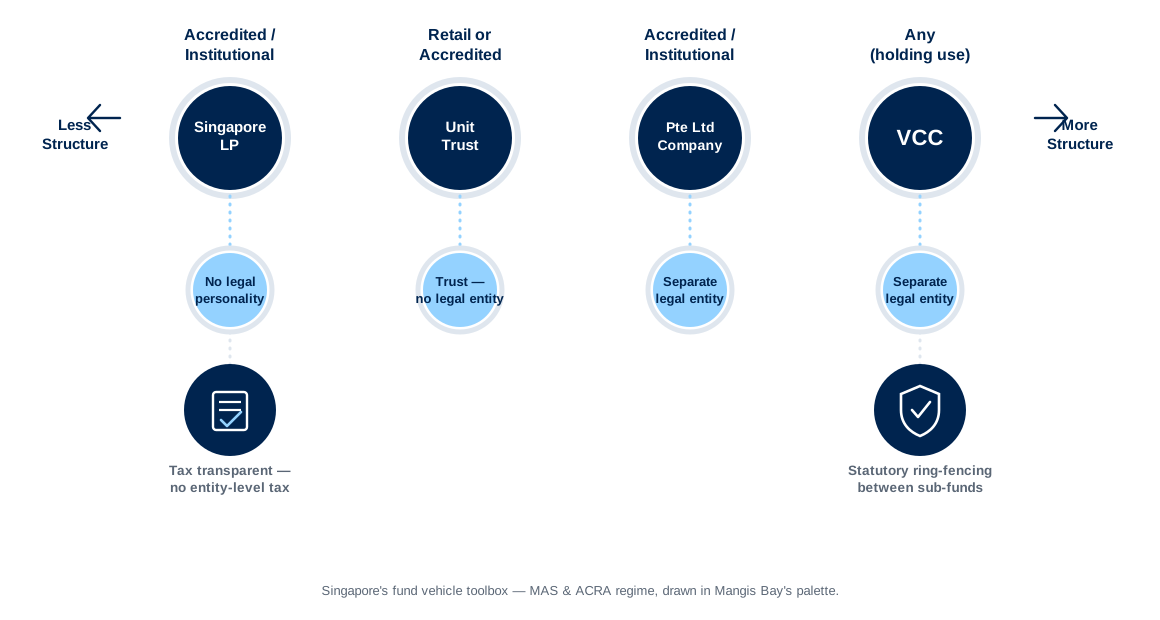
Singapore's fund vehicle toolbox, in Mangis Bay's palette. Source: MAS Asset Management Survey 2024; ACRA VCC & LP registration guidance.
Vehicle incorporation is the fast part in Singapore — fund manager licensing is usually the real bottleneck. Click each step to see what's involved, and where Mangis Bay typically takes the load off your team.
VCC incorporation with ACRA can be as fast as a few business days for a clean, complete filing, though information requests and KYC follow-ups commonly extend this to several weeks. Sub-fund registration under an umbrella VCC is close to instant. A Singapore LP is registered, not incorporated — generally the faster route of the two.
We help you choose between a VCC and an LP based on your actual sub-fund plans and investor base, and coordinate the ACRA filing alongside your legal counsel.
Talk through your structure →Following the repeal of the light-touch Registered Fund Management Company regime (effective 1 August 2024), new managers need either a full Licensed Fund Management Company (LFMC) licence — A/I LFMC for accredited/institutional investors, retail LFMC for public offerings — or, for venture strategies, the lighter-touch Venture Capital Fund Manager (VCFM) registration. MAS's own target is around 4 months for a complete application; real-world timelines commonly run longer for new entrants.
We help you determine which licensing category actually fits your strategy and AUM plans, and can introduce you to licensed third-party managers if a full MAS licence isn't yet the right step.
Discuss your licensing path →The 13O and 13U tax exemption applications are MAS-administered and typically take 8–16 weeks — they should be filed in parallel with incorporation and manager licensing, not treated as a final step. Getting this sequencing wrong is one of the most common (and costly) mistakes we see.
We help assess which scheme fits your fund size and structure, and coordinate with your tax agent on the application and ongoing annual compliance declarations.
See the tax schemes ↓A VCC needs an auditor and a Singapore-resident company secretary by statute, and in practice a fund administrator whose fees also count toward the 13O/13U local business spending test. Bank account opening can add 1–4 weeks (digital banks) to up to 12 weeks (traditional banks).
This is where we add the most value: running a structured selection process across fund administration, audit, company secretarial and banking — see the full breakdown below.
See service providers ↓Choosing the right partners is as important as choosing the right fund vehicle. Click each category to see what it covers and how Mangis Bay helps you select, appoint and manage it.
Not a statutory requirement under the VCC Act, but a near-universal commercial necessity — NAV calculation, investor register and accounting, feeding the mandatory audit.
Mangis Bay's role: we benchmark administrators for sector fit and pricing, noting that their fees also count toward your 13O/13U local business spending test.
MAS generally requires independent custody for a VCC, but PE/VC-strategy VCCs offered only to accredited/institutional investors can be exempted, subject to disclosure and annual audited accounts.
Mangis Bay's role: we help assess whether the custody exemption genuinely applies to your strategy, and identify custodians when it doesn't.
A Singapore-registered public accountant or firm is mandatory for every VCC, appointed within 3 months of incorporation — no audit exemption route exists, unlike ordinary small companies.
Mangis Bay's role: we shortlist auditors with genuine fund and VCC experience, and manage the appointment process.
A natural person ordinarily resident in Singapore is mandatory within 6 months of incorporation — a corporate secretary is not permitted for a VCC, and the role can't be filled by a sole director.
Mangis Bay's role: we help appoint a qualified, experienced company secretary and set up compliant governance from day one.
Assesses eligibility and prepares/files your 13O or 13U application to MAS, then supports ongoing annual compliance declarations once the award is granted.
Mangis Bay's role: we coordinate with your tax agent to keep the incentive application moving in parallel with incorporation and licensing, not behind it.
A VCC needs at least one Singapore-resident director, plus a director who is a qualified representative of the fund manager. Bank account opening timing varies materially by bank type.
Mangis Bay's role: we appoint qualified resident directors and make warm introductions to banks suited to your investor profile, pre-empting AML documentation delays.
A realistic total timeline runs 3–6 months if your manager is already MAS-licensed, but 9 months to 2 years if a new licence is required — the licensing step dominates, not the vehicle set-up.
Mangis Bay can support at every stage of this lifecycle — not only at launch, but through ongoing governance, reporting oversight and service-provider management once the fund is live.
Reformed under MAS Circular FDD Cir 10/2024, effective 1 January 2025. Neither scheme is automatic — both require a MAS award before the exemption applies, so timing the application correctly matters.
minimum AUM in designated investments required for Section 13O (Onshore/Resident Fund scheme), by the third year of the award
minimum fund size for Section 13U (Enhanced-Tier Fund scheme), measured at application and maintained each financial year-end
standard corporate tax rate that applies to any Singapore fund vehicle without 13O/13U status
the 13O/13U exemption, GST remission and associated withholding tax exemption have all been extended through 31 December 2029
Exempts "specified income" from "designated investments" — broadly, gains, dividends and interest from listed/unlisted securities and most fund/real-estate-fund interests — from the standard 17% corporate tax rate. Since 1 January 2025, this requires minimum S$5 million AUM in designated investments by year three, at least 2 investment professionals employed by the Singapore-based manager, and tiered local business spending starting at S$200,000 for funds under S$250m AUM. From 1 January 2025, the new Section 13OA extends equivalent treatment to Singapore-registered limited partnerships, not just companies and VCCs.
We help assess whether 13O genuinely fits your fund size and structure, and coordinate the MAS application with your tax agent from the outset.
Ask about 13O eligibility →Requires a minimum S$50 million fund size and 3 investment professionals, with the same tiered local business spending table as 13O. A major 2025 relaxation: master-feeder and SPV structures previously multiplied the AUM/spending conditions across every entity — now only one set of conditions applies to the whole structure, materially reducing the compliance burden for layered structures.
We help structure master-feeder arrangements to take advantage of the single-condition-set relaxation, and manage the ongoing annual compliance declarations.
Ask about 13U eligibility →Qualifying 13O/13U funds can recover GST on expenses for qualifying investment activities via an annually-set fixed recovery rate, and receive a bundled withholding tax exemption on qualifying payments to non-residents. Standard withholding tax outside this bundle is 15% on interest to non-residents (often reduced under a treaty) and roughly 10% on royalties; there is no withholding tax on dividends under Singapore's one-tier corporate tax system.
VCC sub-funds are treated as separate persons for stamp duty purposes — there is no blanket exemption for intra-umbrella sub-fund-to-sub-fund transfers; each is dutiable on normal terms (standard rate 0.2% on share transfers).
Important sequencing note: the Registered Fund Management Company (RFMC) regime — previously a lighter-touch registration route for smaller managers — was repealed effective 1 August 2024. New entrants now need either a full A/I LFMC licence or the narrower Venture Capital Fund Manager (VCFM) registration; there is no longer a "light" middle path for a new manager entering the market.
Simplified for orientation only — the right answer always depends on your investors, strategy and home jurisdiction. Talk to us before relying on any of this for a real structure.
| Vehicle / status | Corporate tax | Withholding tax (dividends) | Withholding tax (interest) | Treaty access |
|---|---|---|---|---|
| VCC / LP with 13O award | 0% on specified income from designated investments | None (one-tier system) | Exempt (bundled with award) | Full |
| VCC / LP with 13U award | 0% on specified income from designated investments | None | Exempt (bundled with award) | Full |
| Non-qualifying entity | 17% standard rate | None | 15% (reducible under treaty) | Full |
| Singapore LP (no 13O/13U) | Tax transparent — taxed at partner level | Not applicable at fund level | Not applicable at fund level | At investor level |
| Pte Ltd holding co. | 17% standard rate unless separately incentivised | None | 15% (reducible under treaty) | Full |
Singapore's treaty network covers 90+ jurisdictions across Asia, Europe and North America — a genuine differentiator for managers structuring cross-border flows from ASEAN, India, China and Japan, which Cayman or BVI vehicles cannot access directly.
This page is provided for general educational purposes only and does not constitute legal, tax, regulatory or investment advice. Figures are sourced from MAS (Asset Management Survey 2024, Fund Managers guidance, Circular IID 04/2025, Circular FDD Cir 10/2024), ACRA's VCC and LP registration guidance, and IRAS's Tax Framework for VCCs e-Tax Guide. Some figures (including the current-year GST remission rate and family office incentive thresholds) change periodically — rules change and individual circumstances vary, so please speak with us or your own legal and tax advisors before acting on any of this.
Fund managers rarely need help understanding that Singapore works — they need help navigating how to sequence licensing, incorporation and tax incentive applications correctly. Mangis Bay is built to be that single point of contact.
From choosing between a VCC and a Singapore LP to coordinating legal counsel, we help you get from decision to launch without re-learning Singapore from scratch.
We help you determine the right fund manager licensing route — A/I LFMC, retail LFMC, or VCFM — and the realistic timeline that comes with each.
We help time your 13O/13U application correctly, running in parallel with incorporation and licensing rather than as an afterthought.
Structured, benchmarked selection across fund administration, audit, company secretarial and banking — with vetted shortlists, not a single referral.
The Variable Capital Company is a corporate fund structure purpose-built for asset management, with statutory ring-fencing between sub-funds under a single umbrella. It can be used for both open and closed-ended strategies, and over a thousand VCCs have already been set up, most housing multiple sub-funds.
They are Singapore's fund tax exemption schemes, administered by the Monetary Authority of Singapore. Broadly, 13O applies to Singapore-incorporated fund vehicles and 13U to larger, more flexible structures with a higher minimum fund size. Both exempt specified income from Singapore tax, subject to conditions — the details are worth reviewing with an adviser before you commit to a structure.
In almost all cases, yes — fund managers generally need to be licensed or otherwise authorised by the Monetary Authority of Singapore before they can manage a fund in or from Singapore. The exact licensing route depends on your investor base and assets under management.
Both are leading Asian gateways with their own strengths. Singapore offers the VCC's ring-fencing and one of the region's deepest tax treaty networks; Hong Kong offers the LPF, a 0% carried interest concession, and a direct route into Mainland China via the Mutual Recognition of Funds scheme. Many managers end up using both rather than choosing between them.
It's usually driven by MAS licensing timelines for the fund manager rather than by the fund vehicle itself, which can be incorporated quickly. Plan for a few months overall, and start the licensing conversation early.
Whether you're comparing jurisdictions, choosing between a VCC and a Singapore LP, or ready to navigate MAS licensing and the 13O/13U schemes — we'd welcome a conversation. Most engagements start with a short scoping call.
Book a Meeting →