Since the Limited Partnership Fund launched in 2020, Hong Kong has offered PE and VC managers a Cayman-ELP-style onshore vehicle, backed by a self-assessed profits tax exemption and a genuine 0% tax rate on qualifying carried interest. This page breaks down how it actually works, and how Mangis Bay acts as your gateway into the market.
profits tax and salaries tax on qualifying carried interest, since 2021
Open-ended Fund Companies registered as at 30 June 2025, up 81% year on year
two-tiered profits tax rate for any non-qualifying corporate entity
launch years of the OFC and Limited Partnership Fund regimes respectively
new cap (up from 50%) on a Mutual Recognition of Funds vehicle's mainland-sellable assets, since Dec 2024
typical time to register an LPF or private OFC vehicle itself
Source: Securities and Futures Commission (SFC); Hong Kong Inland Revenue Department DIPN 61; Companies Registry.
"Hong Kong's Limited Partnership Fund does for PE and VC managers what the Cayman ELP has done for decades — except onshore, with a genuine tax exemption regime and direct proximity to Mainland China deal flow."
Hong Kong's appeal for private markets managers rests on three pillars: the Limited Partnership Fund, an ELP-equivalent vehicle registered with the Companies Registry in as little as four working days; the Unified Fund Exemption, a self-assessed profits tax exemption regime requiring no upfront application; and the carried interest tax concession, which brings the effective tax rate on qualifying PE carry to genuinely 0%. Add proximity to Mainland China and the Greater Bay Area, plus a re-domiciliation regime that lets an existing Cayman fund relocate to Hong Kong without creating a new legal entity, and the case for managers targeting China-centric strategies is clear.
What's harder to see from outside Hong Kong is that the fund vehicle itself is rarely the bottleneck — SFC Type 9 licensing for the fund manager is. Mangis Bay acts as your gateway to Hong Kong, helping you sequence licensing, vehicle registration and tax positioning correctly, and appointing the right service providers along the way.
Hong Kong offers two flagship routes for a private markets fund — the Limited Partnership Fund (LPF) for closed-end PE/VC, and the Open-ended Fund Company (OFC) for umbrella and multi-strategy platforms — plus the ordinary private company as a holding layer.
Hong Kong's answer to the Cayman/Delaware exempted limited partnership — designed explicitly by government policy to attract PE and VC funds, including Greater Bay Area tech/start-up investment.
Chosen when umbrella/share-class mechanics matter more than the LPF's simpler contractual structure — 579+ registered as at mid-2025, up 81% year on year.
Typically used as the SFC-licensed manager entity or an SPV/holding company beneath an LPF or OFC, rather than as the fund vehicle itself.
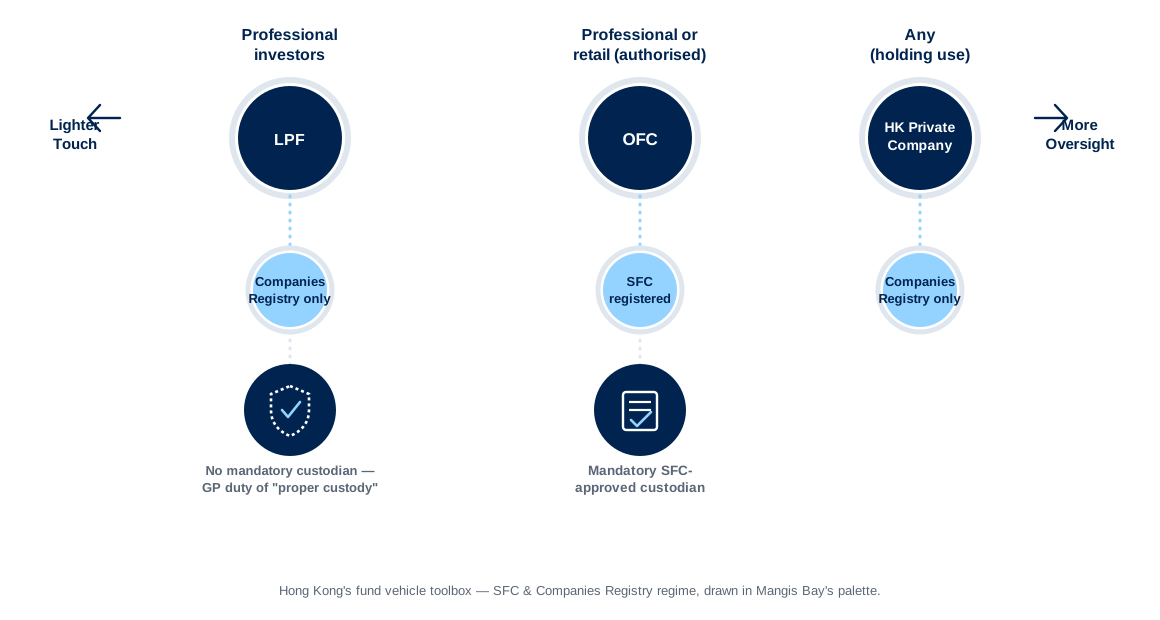
Hong Kong's fund vehicle toolbox, in Mangis Bay's palette. Source: SFC; Companies Registry LPF & OFC guidance.
The vehicle itself registers quickly in Hong Kong — SFC Type 9 licensing for the manager is the real bottleneck. Click each step to see what's involved, and where Mangis Bay typically takes the load off your team.
An LPF is filed via Form LPF1 by a Hong Kong solicitor (self-filing isn't permitted) and typically registers within around 4 working days of a complete application. A private OFC registers with the SFC in generally under a month; a public (retail) OFC takes 1–3 months for full authorisation.
We help you choose between an LPF and an OFC based on your actual strategy and investor base, and coordinate the filing alongside Hong Kong legal counsel.
Talk through your structure →Managing a securities/futures portfolio for others in or from Hong Kong generally requires an SFC Type 9 (asset management) licence — a PE fund's GP needs one unless it has fully delegated all management functions elsewhere. The SFC's own performance pledge is 15 weeks, but realistic elapsed time commonly runs 4–9 months, longer for first-time or complex applicants. A minimum of two Responsible Officers is required, and capital requirements depend on whether the manager holds client assets (HK$100,000 liquid capital if not; HK$5m paid-up capital and HK$3m liquid capital if it does).
We help you plan realistically around SFC timelines — initiating licensing well before vehicle registration — or connect you with an already-licensed third-party manager if that fits better.
Discuss your licensing path →Unlike Singapore's 13O/13U, Hong Kong's Unified Fund Exemption is self-assessed — there's no upfront MAS-style application. But the qualifying conditions (investor count and concentration, the 30% originator-share cap, the 5% incidental-income threshold, and the anti-round-tripping rule) still need to be structured for correctly from day one.
We help structure your fund agreement and investor terms to cleanly satisfy the qualifying conditions, working alongside your Hong Kong tax adviser.
See the tax regime ↓An OFC needs an SFC-approved independent custodian; an LPF has no such mandate, only a GP duty of "proper custody." Both need a Hong Kong-based auditor and registered office, and an LPF specifically needs a named AML/CDD "Responsible Person."
This is where we add the most value: running a structured selection process across custody (where required), audit and registered office/company secretarial services — see the full breakdown below.
See service providers ↓Choosing the right partners is as important as choosing the right fund vehicle. Click each category to see what it covers and how Mangis Bay helps you select, appoint and manage it.
Mandatory for an OFC, SFC-approved and independent of the investment manager — often a Type 1-licensed broker acting as prime broker. An LPF has no mandatory custodian, only a GP duty of "proper custody."
Mangis Bay's role: we identify SFC-eligible custodians suited to your OFC's asset class, including the Type 1 broker route where it fits.
Not a legal requirement for either vehicle — pure market practice for NAV calculation, investor records and transfer agency.
Mangis Bay's role: we benchmark administrators for sector fit, pricing and responsiveness, then manage onboarding.
Mandatory annual audit for OFCs and a Hong Kong auditor requirement for LPFs, independent of the GP/manager; the auditor must hold a valid HKICPA Practising Certificate.
Mangis Bay's role: we shortlist auditors with genuine private equity and fund experience, and manage the tender process.
A Hong Kong registered office (no PO boxes) is mandatory for both vehicles. An LPF also needs a named AML/CDD "Responsible Person" — a bank, licensed corporation, accountant or lawyer, which the GP can sometimes fill itself if qualified.
Mangis Bay's role: we help set up compliant registered office arrangements and appoint a suitable Responsible Person.
The vehicle itself can register in about a week — the realistic total timeline is dominated by SFC Type 9 licensing, typically 4–9 months for a new manager.
Mangis Bay can support at every stage of this lifecycle — not only at launch, but through ongoing governance, reporting oversight and service-provider management once the fund is live.
A Bill to further liberalise both the Unified Fund Exemption and carried interest concession was gazetted 12 June 2026 and is not yet enacted — the summary below reflects current law.
profits tax and salaries tax on qualifying carried interest, applying since 1 April 2020
full-time qualifying investment professionals required in Hong Kong, plus HK$2,000,000 of annual local operating expenditure
maximum share of net proceeds an originator (GP) can take under the fund agreement and still qualify for the Unified Fund Exemption
window to complete de-registration in the original jurisdiction when re-domiciling an offshore fund to Hong Kong as an OFC or LPF
Enacted in 2021 and applying to carry received or accrued on or after 1 April 2020, this concession requires the fund to qualify under the Unified Fund Exemption, be certified by the HKMA, and arise from PE-type qualifying transactions with a market-standard hurdle rate built in. The substance test — at least 2 full-time qualifying investment professionals in Hong Kong and at least HK$2,000,000 of local operating expenditure per year — is assessed alongside a facts-and-circumstances "adequacy" test.
We help assess whether your carry structure and Hong Kong substance genuinely meet the certification requirements, working with your tax adviser on the HKMA application.
Ask about the carry concession →Since 1 November 2021, an offshore fund (typically a Cayman company) can relocate its registration to Hong Kong as an OFC or LPF without creating a new legal entity — existing contracts, rights and obligations continue uninterrupted. Because this isn't treated as a change of beneficial ownership, no stamp duty applies. De-registration in the original jurisdiction must complete within 60 days (extendable).
We help assess whether re-domiciliation genuinely suits your fund versus launching fresh, and coordinate the parallel Hong Kong registration and offshore de-registration process.
Ask about re-domiciliation →The Mutual Recognition of Funds arrangement with mainland China was liberalised on 17 December 2024 — the CSRC raised the cap on a Hong Kong-recognised fund's mainland-sellable assets from 50% to 80%, and now permits sub-delegation of investment management to an overseas group affiliate. Wealth Management Connect (2021) provides a further Greater Bay Area cross-border retail wealth bridge.
Hong Kong's edge is proximity and connectivity to Mainland China; Singapore's treaty footprint tends to win for pan-Asian, ASEAN and India-weighted strategies instead.
Simplified for orientation only — the right answer always depends on your investors, strategy and home jurisdiction. Talk to us before relying on any of this for a real structure.
| Vehicle / status | Profits tax | Carried interest | Withholding tax | Stamp duty |
|---|---|---|---|---|
| LPF / OFC qualifying under UFE | 0% on qualifying transactions | 0% if HKMA-certified | None (territorial system) | None on LPF interests; OFC shares exempt |
| Non-qualifying corporate entity | 8.25% (first HK$2m) / 16.5% thereafter | Taxable as ordinary income | None | 0.1% each side on HK stock transfers |
| Unincorporated business | 7.5% (first HK$2m) / 15% thereafter | Taxable as ordinary income | None | Not applicable |
Hong Kong has no withholding tax on dividends or interest to any recipient regardless of residency, under its territorial tax system — though investors may still be taxed at home under worldwide-income rules.
This page is provided for general educational purposes only and does not constitute legal, tax, regulatory or investment advice. Figures are sourced from the Hong Kong Inland Revenue Department (DIPN 61), the SFC (Fund Manager Code of Conduct, OFC & LPF guidance, Circular 20EC2), and the Companies Registry. A Bill to liberalise the Unified Fund Exemption and carried interest regime was gazetted 12 June 2026 but is not yet law — rules change and individual circumstances vary, so please speak with us or your own legal and tax advisors before acting on any of this.
Fund managers rarely need help understanding that Hong Kong works — they need help navigating how to sequence SFC licensing, vehicle registration and tax positioning correctly. Mangis Bay is built to be that single point of contact.
From choosing between an LPF and an OFC to coordinating legal counsel, we help you get from decision to launch without re-learning Hong Kong from scratch.
We help you plan realistically around Type 9 licensing timelines, or connect you with an already-licensed third-party manager where that fits better.
We help structure your fund agreement to cleanly satisfy the Unified Fund Exemption and, where relevant, the carried interest concession's substance test.
Structured, benchmarked selection across custody, audit and registered office services — with vetted shortlists, not a single referral.
The Limited Partnership Fund is Hong Kong's dedicated private equity and venture capital vehicle. It doesn't require a mandatory custodian — the general partner instead carries a statutory duty of "proper custody" — which keeps cost and complexity down for closed-ended strategies.
Qualifying carried interest can be taxed at 0% under Hong Kong's carried interest tax concession, subject to conditions around fund qualification and substance. It's a significant advantage for PE and VC managers based or expanding there.
Yes. Hong Kong operates a re-domiciliation regime that lets funds originally set up elsewhere re-register locally, subject to conditions and de-registration timelines in the originating jurisdiction. It's a realistic option for managers who set up offshore early and want a Hong Kong nexus later.
Typically an SFC Type 9 (asset management) licence, though the exact requirement depends on your activities and client base.
Yes, via the Mutual Recognition of Funds scheme, which allows eligible Hong Kong funds to be distributed into Mainland China (and vice versa) under a streamlined approval process.
Whether you're comparing jurisdictions, choosing between an LPF and an OFC, or ready to navigate SFC licensing and the carried interest concession — we'd welcome a conversation. Most engagements start with a short scoping call.
Book a Meeting →